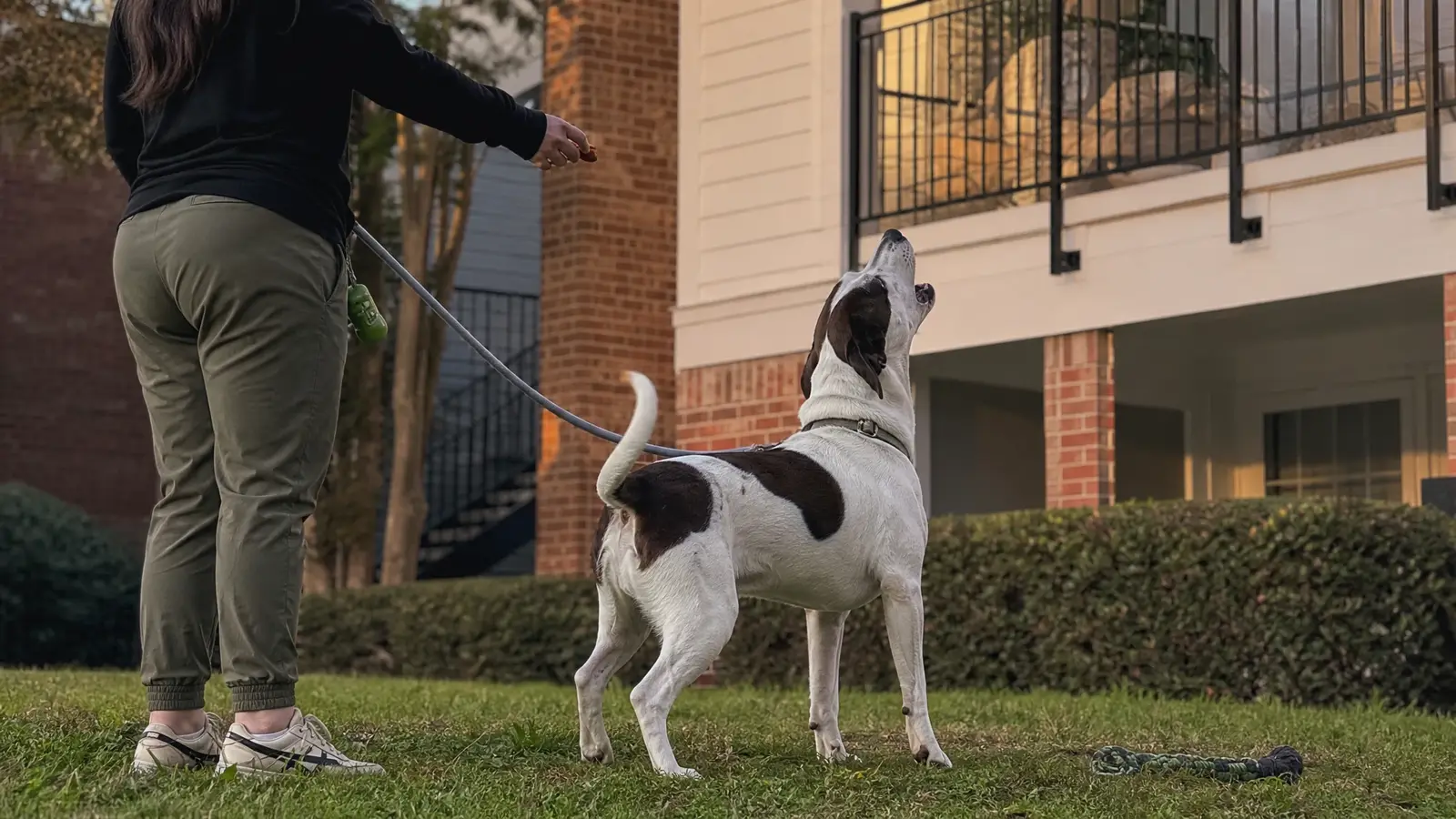
Dogs bark to say something, and the fix is to find out what, then change the trigger, the setup and your dog's habits with rewards. We help Arlington owners cut barking without bark collars or punishment, and we explain what the city's complaint process involves so you can stay ahead of it.
Tell us when your dog barks, from the balcony to the backyard fence
- In-person training in Arlington and nearby areas
- Online training anywhere
- Reward-based methods only
Why does my dog bark so much, and what is it telling me?
Different barks have different causes, and the cause decides the fix. Match the pattern to the likely reason before you train.
| Pattern | Likely cause | What helps |
|---|---|---|
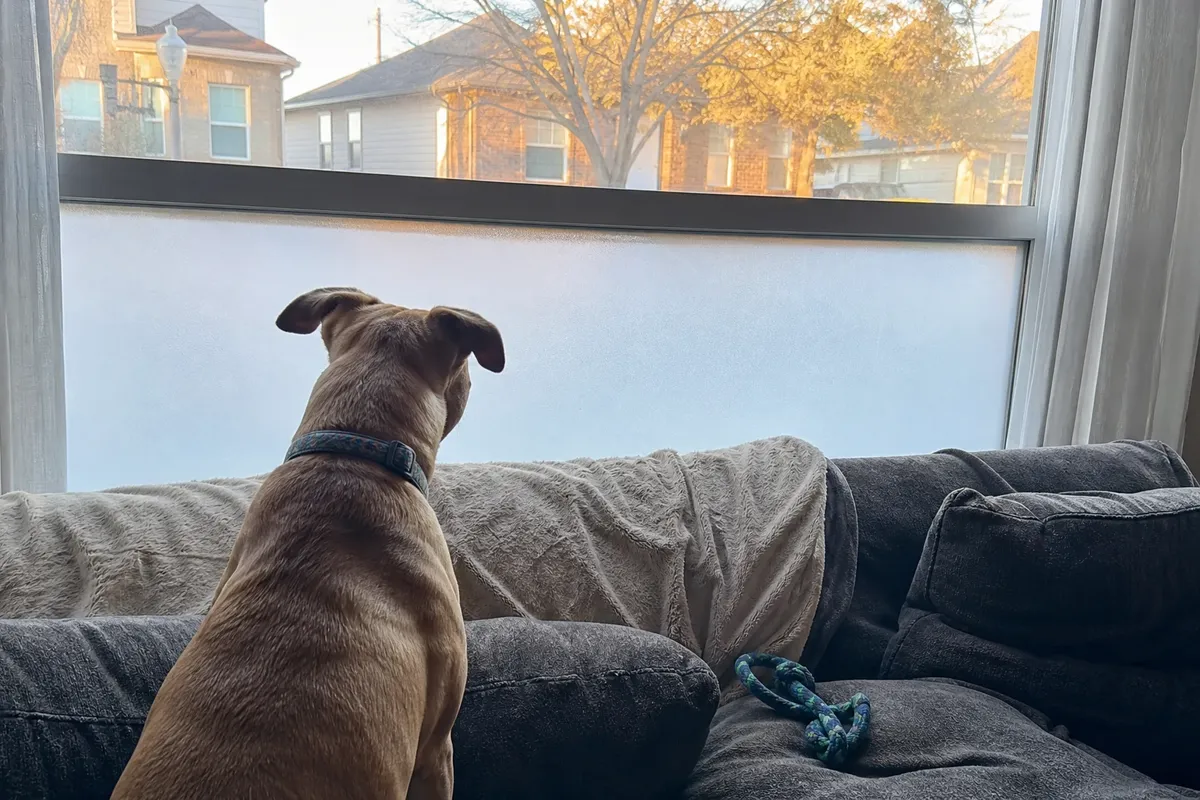
| At the window, fence or door when people or dogs pass | Alerting or territorial excitement | Block the view, reward quiet, teach go-to-mat |
| Barking when you leave | Distress; see separation anxiety | Gradual absence training |
| Demand barking at dinner or on the couch | Attention-seeking that has worked before | Reward quiet, ignore barking, give attention when calm |
| Outside at night | Wildlife, sounds, boredom | Bring dog inside, supervise yard time |
| Reactive barking on walks | Fear or frustration; see leash reactivity | Distance and counter-conditioning |
What can I do today to reduce barking?
Start with management, because it works fastest. A dog that is not allowed to practice barking all day stops getting rewarded for it.
- Cover the lower half of windows with film, or close blinds on the street side.
- Keep your dog off the balcony or fence line when you cannot supervise.
- Add a mental job: a food puzzle, a sniffy walk or a chew.
- Reward every quiet moment, especially right after a trigger.
- Do not shout. To your dog, it can sound like you are barking along.
- Check the basics with your vet if barking starts suddenly in an older dog.
Most barking improves faster when exercise and routine are in place before training starts.
Common mistakes we see: letting a dog bark at the fence all afternoon because it is "just outside," giving a treat in the middle of a barking fit (which pays for the bark), and expecting results from a single long session. Instead, reward the pause, keep sessions to a few minutes and repeat them through the week. Also remember that a tired dog is not a trained dog: extra exercise helps, but the dog still needs to learn what to do instead of barking.
What does Arlington do about barking dogs?
Last verified 2026-11-11. The City of Arlington's Barking Dogs Complaint Process recommends neighbors try open communication first. If that does not work, the complainant submits a notarized affidavit to Arlington Animal Services with the date or dates, times and duration of the noise. The page does not state a minimum number of days or complainants, and a citation is not certain. For specifics, read the city page.
Here is a common situation Arlington owners face: a dog on a second-floor balcony barks at every passing dog and jogger, and the neighbors below start keeping a log. Roughly 45% of Arlington households rent, according to RentCafe citing Census data (RentCafe summary), so shared walls and balconies are an everyday reality for many local dogs.
Two Arlington-specific triggers deserve a plan. First, the city says wildlife is most active between dusk and dawn and advises close supervision of small pets in backyards (City of Arlington wildlife guidance), which is a good reason not to leave a barking dog outside overnight. Second, fireworks use is illegal in Arlington with a fine up to $2,000, yet the July 4 period is when most pets go missing (City of Arlington, Independence Day pet safety). Dogs that bark at fireworks are often afraid, and that needs desensitization rather than a bark correction.
How we train excessive barking
We treat barking as a behavior with a cause. We never use bark collars that shock, spray or vibrate to punish. The AVSAB position says aversive methods should not be used (AVSAB statement via Purdue).
- Log the pattern. We ask you to note when, where and what happens right before barking.
- Manage the setup. Visual barriers, white noise, scheduled exercise and safe spaces.
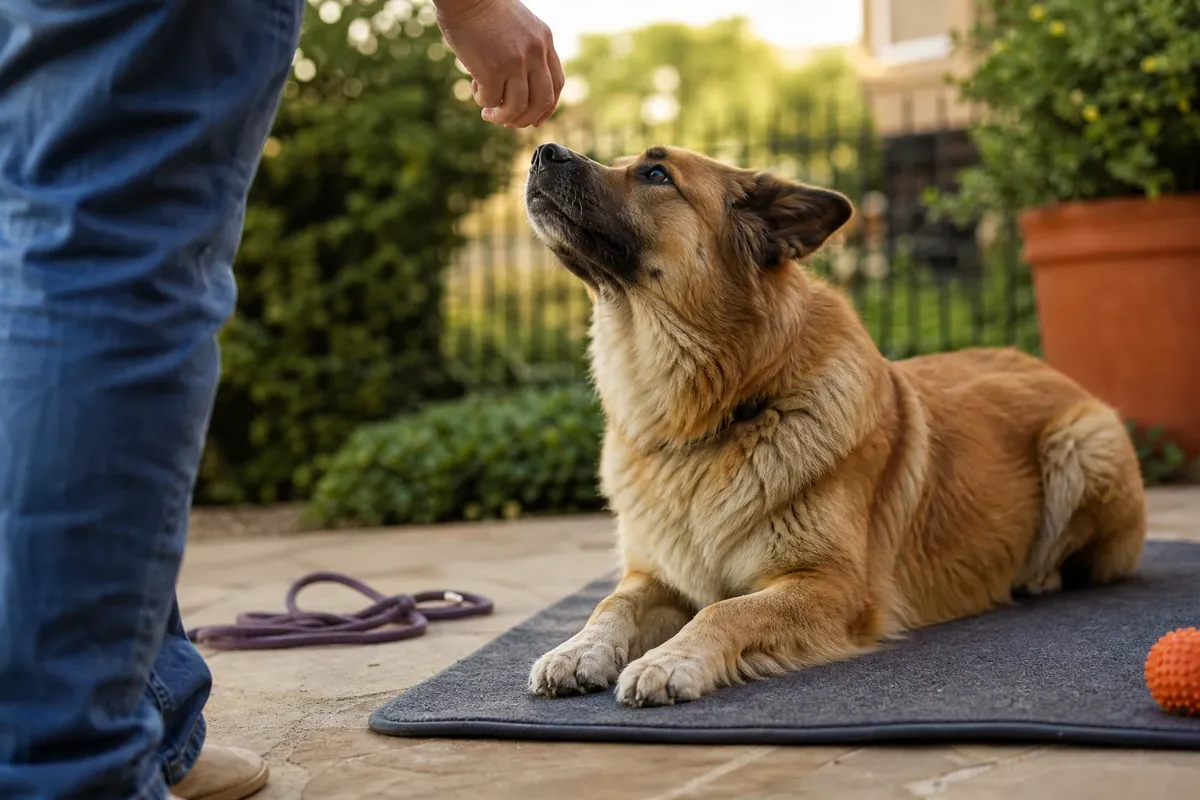
- Teach a quiet alternative. A mat, a hand target or a find-it game gives the dog a different job.
- Desensitize triggers. We play real doorbell or hallway sounds at low volume and pair them with food, raising the level only when your dog stays calm.
- Reward quiet. Pay the dog when it stops, and reinforce quiet before it starts.
- Coach the household. Everyone follows the same rules, so the dog is not confused.
Short, consistent practice beats long sessions. How fast barking drops depends on the dog and on how consistently the household follows the plan.
Is in-person or online training better for barking?
Barking is highly location-specific, so seeing your windows, yard and hallways helps. In-person training is best when the barking happens at home with visitors or neighbors. Online works well for video review, trigger logs and follow-up. Compare in-person private training with online dog training, then apply with a short video of the barking if you can.
Frequently asked questions
Can the city fine me for my dog's barking?
The city has a complaint process that starts with neighbor communication and can involve a notarized affidavit to Animal Services. It states no minimum number of days or complainants, and a citation is not certain. Read the city page for current details.
Do anti-bark collars work?
They can suppress barking by startling or hurting a dog, but they do not fix the reason. We use reward-based training and management instead.
How do I talk to a neighbor about my dog barking?
Listen first, thank them for raising it and share your plan and a rough timeline. The city itself recommends neighbors try open communication before filing.
Should I let my dog bark it out?
No. Barking that is not addressed tends to get stronger because the dog gets practice and often gets results. Interrupt the setup and reward quiet instead.
Does a bigger yard fix barking?
Not usually. Dogs left outside often bark more because they see and hear every trigger. Time outdoors works best when supervised, with a job to do.
Keep reading
- Separation anxiety training in ArlingtonRead more →
- Apartment dog training in ArlingtonRead more →
- Fireworks and storm fear helpRead more →
- In-person private dog training in ArlingtonRead more →
- Online dog training for barkingRead more →
- Apply for trainingRead more →
Sources
- City of Arlington, Barking Dogs Complaint Process (last verified 2026-11-11)
- RentCafe, Arlington TX rental market (third-party summary of Census data) (last verified 2026-11-11)
- City of Arlington, Coexisting Safely with Urban Wildlife (Sept 2026) (last verified 2026-11-11)
- City of Arlington, Prioritize Pet Safety During Independence Day Celebrations (June 2026) (last verified 2026-11-11)
- AVSAB humane dog training position (via Purdue Canine Welfare Science Center) (last verified 2026-11-11)
Tell us when your dog barks, from the balcony to the backyard fence
- In-person training in Arlington and nearby areas
- Online training anywhere
- Reward-based methods only