Off-Leash Dog Parks in Arlington and How to Train for Them
General training information. For aggression, sudden behavior changes or health concerns, see your veterinarian first.
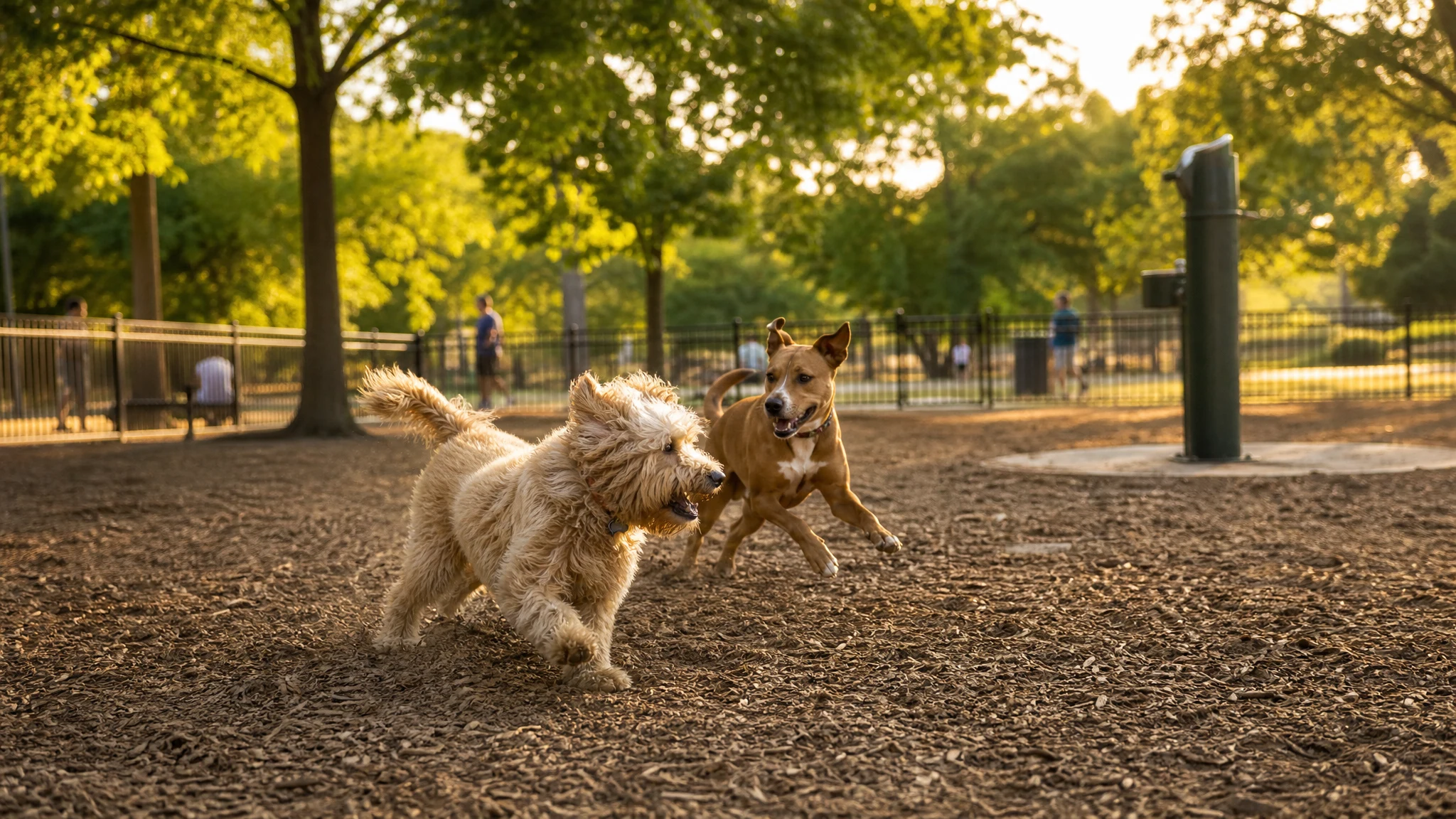
A fenced field and a pack of happy dogs sounds like the perfect Saturday. For some dogs it is. For others, the first visit is overwhelming, or it goes wrong in a way that could have been avoided with a few weeks of practice at home.
This guide covers the dog parks Arlington lists, what the city says about each one, and a step-by-step plan for the skills your dog needs before the gate closes behind you. If you are looking for an off leash dog park near Arlington, start with the three places below.
Off-leash dog parks in Arlington
The City of Arlington lists the following off-leash spaces. Details such as hours can change, so confirm with the city before you go.
Rush Creek Dog Park
Address: 1900 Valleywood Dr., Arlington, TX 76013. According to the City of Arlington, the park is free to use and allows up to three dogs per visit. Owners must clean up after their pets.
Dogs stay on leash until they are inside the double-gated entry. The park is closed each Wednesday until 12:00 p.m. for maintenance. The city's page lists no regular operating hours, so check with the city for those. The rainout line is 817-462-8441.
Tails 'N Trails Dog Park
Address: 950 SE Green Oaks Blvd., Arlington, TX 76018. The City of Arlington describes this park as fully fenced and off-leash, open during daylight hours at no charge. It is closed each Tuesday until 12:00 p.m. for maintenance. The rainout line is 817-462-8441.
The city's page does not give a detailed rule list. Watch for posted signs at the entrance and ask the city if you have questions.
Doggie Depot in Downtown Arlington
Address: 105 N Mesquite St., Arlington, TX 76011. The City of Arlington announced that Doggie Depot opened on March 13, 2025. The city's article does not list hours, fees or rules. Visit the Downtown Arlington Doggie Depot page or check with the city for current details before your first trip.
Rules to confirm before you go
The pages I relied on do not state a citywide leash rule outside of dog parks. Check with Arlington Animal Services at 817-459-5898 for the current leash requirements and for any other rules that apply to your dog on the way to and from the park.
Arlington also requires dogs to be licensed. The city's pet registration portal requires proof of current rabies vaccination. The city's own pages list different fee amounts, so ask Animal Services or use the city's registration portal for the current figure.
Texas law, under Health and Safety Code Sec. 826.021, requires a dog to be vaccinated against rabies by 4 months of age and at regular intervals after that. Keep your dog's vaccination paperwork current before any group outing.
Is your dog ready? What you need first
Off-leash parks reward dogs who can do four things: come when called, check in with you, read other dogs' body language, and leave calmly. Each one is a skill you can build in your own yard, in the house, or on a quiet Arlington sidewalk.
Materials
- A flat buckle collar or a well-fitted harness, plus an ID tag
- A 6 ft leash for daily walks and a long line (15 to 30 ft) for recall practice
- Small, soft treats your dog loves, kept in a pouch
- A favorite toy for dogs who love play more than food
- Water and a collapsible bowl
- Poop bags, since the city requires owners to clean up
- Current rabies paperwork and your dog's license
You do not need any tool that causes pain or fear. The American Veterinary Society of Animal Behavior (AVSAB) recommends reward-based training, and that is the approach used here.
Step-by-step training plan
Step 1: Build a reliable name response
Start inside, with no distractions. Say your dog's name in a happy voice. The moment they look at you, say "yes!" and give a treat. Repeat ten times, a few times a day.
Once your dog looks at you almost every time, move to the backyard, then to a quiet street. The name should always predict something good.
Common mistake: using the name to scold. If your dog hears their name before something unpleasant, they learn to tune it out.
Step 2: Teach recall on a long line
Pick a word you will use only for this, such as "come" or "here." Say it once, in a cheerful voice, while backing up a few steps. When your dog reaches you, give several treats in a row. Jackpot rewards make coming back the best choice.
Practice in a fenced yard or a quiet open area with the long line attached. Increase the distance slowly. Add distractions one at a time: a toy on the ground, a family member walking by, a distant dog.
Common mistakes:
- Calling your dog only to end fun. Sometimes call, treat, and release them back to play.
- Repeating the cue over and over. Say it once, then help with the line or move toward them.
- Chasing. Running after a dog usually turns recall into a game of keep-away. Run the other way instead.
- Dropping the long line too early. Keep it on until recall works around real distractions.
Step 3: Reward check-ins
A dog who checks in on their own is far easier to manage in a busy park. On walks, any time your dog glances at you without being asked, mark it and reward. Do this at home, then on sidewalks, then near your neighborhood park.
Over time, your dog learns that staying aware of you pays off. At the dog park, that habit lets you spot trouble early and call your dog out before things escalate.
Step 4: Practice a calm gate routine
Rush Creek Dog Park keeps dogs on leash until they are inside the double-gated entry, so practice that moment before you go. Wait at a doorway at home. Ask for a sit. Open the door only when your dog is calm. Reward, then release with a cue like "free."
Repeat this at a car door and at a gate. A dog who bursts through the entry at full speed starts the visit wound up, and other dogs notice.
Step 5: Learn to read play
You are your dog's advocate, so learn what healthy play looks like.
Signs of good play often include:
- Loose, wiggly bodies
- Play bows, with front down and rear up
- Taking turns chasing and being chased
- Short breaks, then returning for more
Signs to step in and calmly leave:
- Stiff bodies, hard stares or freezing
- A dog tucking their tail and trying to hide behind you
- One dog repeatedly pinning or cornering another
- Growling or lunging that does not settle quickly
- Dogs piling onto a single dog
Watch other dogs from outside the fence first. Spend a few minutes at the fence line so you can see how the group is behaving before you enter.
Step 6: Teach a calm exit
Leaving is one of the hardest parts of a park visit. Practice in the yard. Call your dog out of play with your recall cue, reward, clip on the leash, then release them back to play. Do this several times so a leash does not always mean the fun is over.
When you are ready to go home, call your dog away from the group before they get overheated or tired. End on a good note. Walk to the gate, leash up inside the entry, and reward calm walking out.
Step 7: Start small
Your first visit does not need to be long. Pick a quiet time, since busy weekend hours can mean more dogs and more chaos. Keep it to ten or fifteen minutes. Stay close, bring treats, and leave while your dog is still doing well.
Rush Creek allows up to three dogs per visit, so plan ahead if you have a larger household. For anything else, ask the city.
Arlington heat and park safety
North Texas summers can make a fun outing risky. The City of Arlington suggests checking the surface with the back of your hand. If it is uncomfortable or painful to hold your hand there for longer than 5 seconds, it is too hot for your dog's paws.
City of Arlington advice on soaring temperatures also includes these points:
- Never leave an animal in a parked vehicle.
- Give plenty of fresh water.
- Keep dogs off hot asphalt, because paw pads can burn.
- Watch for heavy panting.
- Flat-faced animals are more susceptible to heat stroke.
If your dog collapses, vomits, or pants heavily and cannot settle in the heat, call a veterinarian right away. Heat stroke is an emergency.
When a dog park is not the right fit
Not every dog enjoys the dog park, and that is fine. A dog park may not suit your dog if they:
- Are under the age or vaccination status that your veterinarian considers safe for group settings
- Are very fearful, and hide, shake or try to escape
- Guard toys, treats, water or you
- Are not yet reliable on recall
- Are in heat, injured, or recovering from illness
- Are older or in pain, and may not tolerate rough play
Good alternatives include sniff walks, one-on-one play dates with a dog you know, a fenced yard with a long line, and training games at home.
If your dog has growled, snapped or bitten a person, skip the dog park. Talk with your veterinarian and a certified behavior professional. Arlington's dangerous animal process, described on the City of Arlington's Dangerous Dogs page, involves written, notarized reports and registration requirements, so it is worth getting help early. A pain or medical cause is also worth ruling out with your veterinarian.
Tips for a smoother visit
- Exercise your dog lightly first, so they are not bursting with energy at the gate.
- Clean up after your dog every time. The City of Arlington requires owners to do so at Rush Creek.
- Keep your attention on your dog. Skip the phone scroll.
- Leave toys and treats at home if your dog guards them, or if other dogs might.
- Call the rainout line, 817-462-8441, if weather looks questionable.
- Plan around closures: Rush Creek on Wednesday mornings and Tails 'N Trails on Tuesday mornings.
What to expect
With short, regular practice, many dogs show better name response and check-ins within a few weeks. Recall around real distractions often takes longer, sometimes months, and it can vary with age, breed and history. Progress is rarely a straight line, and a bad day does not erase earlier work.
These steps may help your dog handle the park with less stress. They cannot promise a perfect visit, because other dogs and owners are outside your control. If a session goes badly, step back to the previous step and try again.
Need hands-on help?
If recall or reactivity feels like too much to handle alone, a qualified, reward-based trainer can coach you. For a look at what training options look like locally and how to think about costs, read our guide to dog training in Arlington, where to train and what it costs.
Sources
- City of Arlington, Rush Creek Dog Park
- City of Arlington, Tails 'N Trails Dog Park
- City of Arlington, Doggie Depot grand opening
- City of Arlington, Animal Services pet registration
- Texas Health and Safety Code Sec. 826.021
- City of Arlington, Dangerous Dogs
- City of Arlington, Heat Safety Tips for Enjoying Arlington Parks This Summer
- City of Arlington, Keep Pets Safe During Soaring Temperatures