Help for a Reactive or Aggressive Dog in Arlington
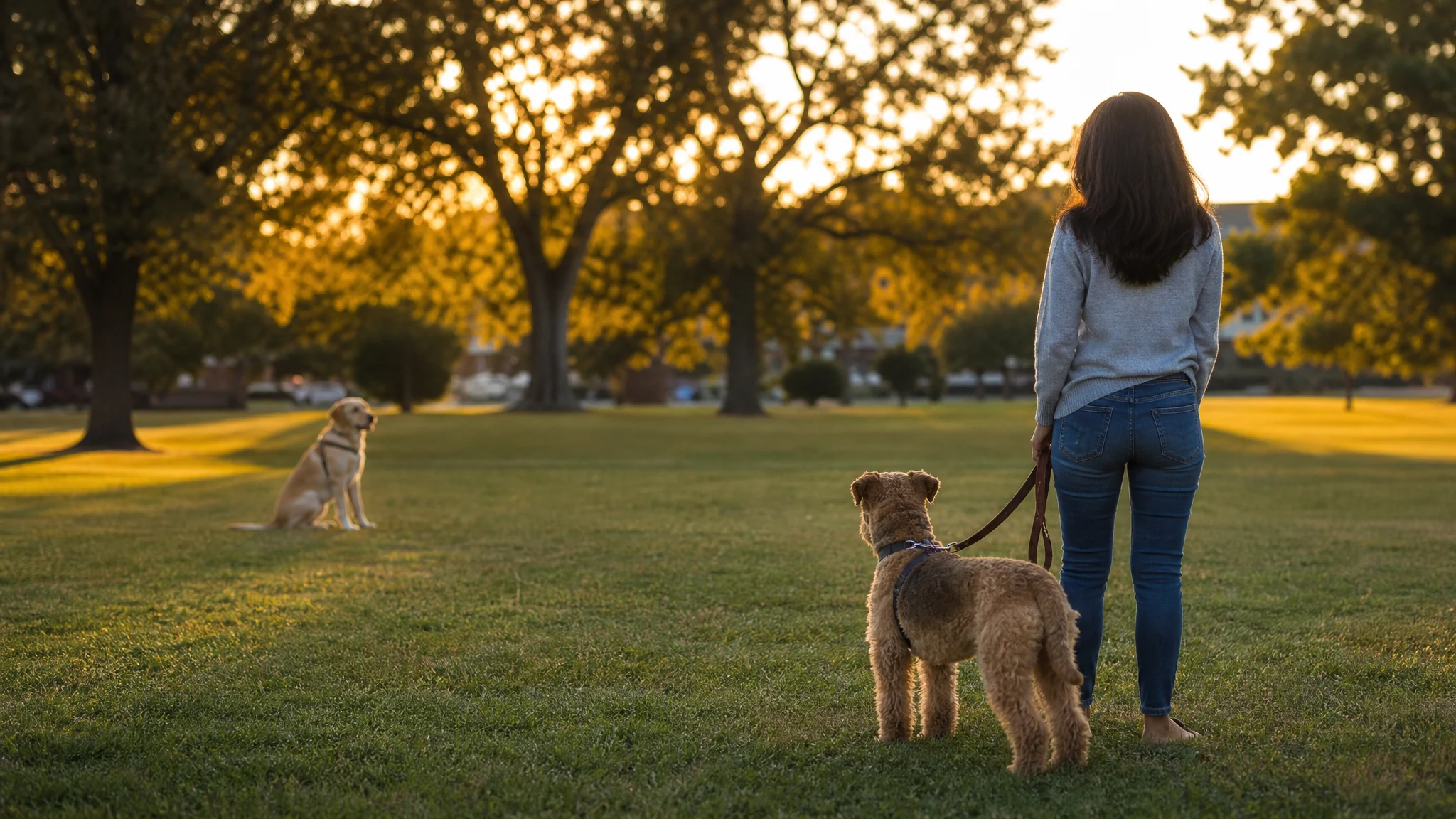
General training information. For aggression, sudden behavior changes or health concerns, see your veterinarian first.
If your dog lunges, barks, or snarls at other dogs, strangers, or bikes, you are not alone, and you are not a bad owner. Living with a reactive dog is stressful. Walks feel like a gamble, and you may start avoiding the neighborhood altogether.
This guide walks you through the basics of reactive dog training at home: what reactivity is, how to keep everyone safe, which methods help, and when to bring in a veterinarian or a professional. It also covers what Arlington, Texas says about dangerous dogs, and where to look for local trainers.
What reactivity and aggression actually mean
A reactive dog overreacts to a trigger. The trigger might be another dog, a person, a skateboard, or a delivery truck. The reaction often looks big: barking, lunging, growling, or spinning at the end of the leash.
Reactivity is usually about big feelings, not a bad dog. Fear, frustration, and over-excitement are common roots. The dog is trying to make something scary or exciting go away, or get closer to it.
Aggression is a broader word. It describes behavior meant to threaten or harm, such as snapping or biting. A reactive dog may never bite, but a dog that has bitten or seriously threatened someone needs a different level of care. More on that below.
Signs your dog is getting stressed
- A stiff body, hard stare, or closed mouth
- Ears pinned back or tail tucked
- Lip licking, yawning, or turning the head away
- Raised hackles along the back
- Growling or barking before a lunge
Learning these early signals lets you step in before the big reaction.
Safety first
Before any training, make a safety plan. Training works best when nobody gets hurt and your dog is not repeatedly pushed over the edge.
- Use a well-fitted flat collar or a front-clip harness, plus a sturdy leash. Check the fit and the hardware before each walk.
- Keep your dog away from children and visitors who cannot stay calm and respectful around them. Use a closed door, a gate, or a crate when guests come over.
- Do not take a reactive dog to a busy off-leash space to "work it out." Crowded dog parks are a poor place to start.
- Never leave your dog unsupervised with a person or animal it has threatened.
- If your dog has bitten someone, call your veterinarian and a certified behavior professional right away. Do not wait for it to pass.
A basket-style muzzle can be a useful safety tool when it is introduced slowly with treats, so your dog learns to like it. Ask a trainer to show you how.
The Arlington dangerous dog rule
It helps to know where the line is drawn locally. The City of Arlington's Dangerous Dogs page, citing Animals Chapter Art. VIII Sec. 8.01 and Texas Health and Safety Code 822.041, defines a dangerous animal as one that makes an unprovoked attack on a human causing bodily injury.
According to the city, reports must be in writing and notarized, and the owner is notified in writing. The owner may appeal to a justice, county, or municipal court within 15 days.
If a dog is registered as dangerous, the city lists these requirements:
- A secure enclosure, or a muzzle with a leash of 6 feet or less under the control of a capable person
- A $100,000 liability policy
- A $50 annual renewal fee
- A tag worn at all times
- Proof of rabies vaccination
Reactivity alone is not the same as a dangerous dog designation. Still, a dog that bites is a legal and safety matter as well as a training one. For questions about your own situation, contact Arlington Animal Services at 817-459-5898 or read the city's Dangerous Dogs page.
Why punishment makes it worse
It is tempting to correct a dog that is lunging at the end of the leash. Please resist. The American Veterinary Society of Animal Behavior (AVSAB) recommends reward-based training and advises against punishment-based methods for behavior problems, including aggression.
Here is the reasoning. A reactive dog is already upset. Yelling, leash jerks, or painful tools add more stress and can teach the dog that its trigger predicts something awful. That can make the reaction stronger, or cause a dog to stop giving warning signs and bite with less notice.
For that reason, avoid shock collars, prong collars, choke collars, alpha rolls, scruffing, and any "dominance" approach. They are not needed, and they put people and dogs at risk.
How to start reactive dog training at home
Materials you will need
- A flat collar or front-clip harness, and a 4 to 6 foot leash (not a retractable one)
- Small, soft, high-value treats such as tiny pieces of cooked chicken or cheese
- A treat pouch you can reach quickly
- A quiet space at home with a baby gate or closed door
- A notebook to record triggers, distances, and progress
- Optional: a basket muzzle, introduced gradually
Step 1: Rule out pain and illness
Schedule a veterinary visit before you begin. Pain, thyroid problems, hearing or vision loss, and other medical issues can cause or worsen reactive behavior. Tell your vet exactly what you see and when it happens. Video clips can help.
Texas Health and Safety Code Sec. 826.021 requires dogs to be vaccinated against rabies by 4 months of age and at regular intervals after that. Arlington also asks for proof of current rabies vaccination for its pet license. Keep your dog's vaccines current, especially if you ever have a bite incident.
Step 2: Find your dog's threshold distance
The threshold is the distance at which your dog notices a trigger but can still take a treat and think. Past that point, your dog is too worked up to learn.
On a walk, watch for the moment your dog first stiffens or stares. Then increase the distance until your dog looks relaxed. That comfortable gap is where training happens. For some dogs it is half a block. For others it is the far side of a parking lot.
Step 3: Use counter-conditioning
Counter-conditioning changes how your dog feels about a trigger. The idea is simple: trigger appears, good things happen.
- Stay at a distance where your dog is calm.
- The moment your dog notices the trigger, say a cheerful marker word such as "yes."
- Feed several small treats, one after another, while the trigger is visible.
- When the trigger leaves, the treats stop.
Over many repetitions, the trigger can start to predict treats instead of trouble. Your dog may begin to look at you with a relaxed face when it sees another dog.
Step 4: Add desensitization
Desensitization means exposing your dog to the trigger at a level so low it does not cause a reaction, then slowly raising the intensity. The two methods are usually used together.
Make changes in tiny steps. Move a few feet closer, or let the trigger be a bit more active, but only after your dog stays relaxed at the current level for several sessions. If your dog reacts, you moved too fast. Go back to an easier distance and try again later.
Step 5: Teach your dog easy, rewarding skills
Practice these at home first, then in quiet places, before trying them near triggers:
- Look at me: reward your dog for checking in with you.
- U-turn: cheerfully say "this way," turn around, and walk off while giving treats.
- Hand target: your dog touches your palm with its nose for a treat, which is a handy way to move them past a trigger.
These give you an escape plan. If a trigger appears closer than expected, you can calmly leave without a scene.
Step 6: Keep sessions short and plan your walks
Aim for five to ten minutes of focused practice, then finish on a good note. Pick quieter times and places for walks. Early mornings often work well, especially in the heat of an Arlington summer.
Many owners find it helpful to walk in wide, open areas where they can see triggers coming and cross the street or turn around. Avoid tight spots where a surprise dog could pop out.
Arlington heat and your reactive dog
Heat makes everything harder. A hot, uncomfortable dog is a more stressed dog. The City of Arlington's parks guidance says to check the pavement with the back of your hand. If it is uncomfortable or painful to hold your hand there for longer than 5 seconds, it is too hot for your dog's paws.
The city also advises never leaving animals in a parked vehicle, giving plenty of fresh water, and watching for heavy panting. Flat-faced dogs are more susceptible to heat stroke. On very hot days, swap the walk for indoor games and short training sessions in the house.
Tips and common mistakes
Tips that help
- Praise and pay for calm behavior, even small moments, such as a glance away from a trigger.
- Keep treats better than usual. Ordinary kibble often is not enough near a trigger.
- Stay relaxed and breathe. Dogs notice tension in the leash and in your body.
- Give your dog a safe spot at home to rest without interruptions.
- Track progress in a notebook so you can see small wins over weeks.
Common mistakes to avoid
- Getting too close, too soon. This is the most frequent reason training stalls.
- Using punishment. As covered above, it can raise stress and risk.
- Forcing greetings. "Let them say hi" can turn a small problem into a big one.
- Training only after a reaction. Practice before the dog is over threshold.
- Skipping the vet. Medical causes are easy to miss.
- Expecting a straight line. Good days and bad days are normal.
When to see a veterinarian or a veterinary behaviorist
Call your veterinarian if the behavior starts suddenly, gets worse quickly, or comes with changes in appetite, sleep, or movement. A veterinarian can check for pain or illness and talk through whether medication might support training.
A veterinary behaviorist is a veterinarian with extra training in behavior problems. If your dog's reactions are intense, frequent, or involve biting, ask your veterinarian whether a referral makes sense. I do not have a verified local veterinary behaviorist to name for Arlington, so please ask your own vet for a referral.
If your dog shows aggression toward people, see a veterinarian and a certified behavior professional. Do not try to handle it alone.
Finding local help in Arlington
Many owners find that a professional makes reactive dog training much easier, since a trainer can watch your dog and fine-tune your timing. When you look for aggressive dog training in Arlington, choose a reward-based professional and ask about their methods before you book. If someone mentions shock, prong, or choke collars, or "dominance," move on.
These trainers are listed in the sources I reviewed. I am not ranking or recommending them, and I cannot say whether each one works with reactive or aggressive dogs. Please contact them, ask about their experience with reactivity, and confirm service areas and credentials yourself.
- Stacy Greer, Sunshine Dog Training & Behavior. Her own site shows CPDT-KA, and she is also listed as a Fear Free Certified Professional and AKC CGC Evaluator. She serves the DFW area. Her own site does not mention Arlington, though the DFW Force-Free Trainers Network lists Arlington among her areas.
- Jennifer (Jenny) Kraus, Wiggle Butt Academy. The CCPDT directory profile lists CPDT-KA and Certified Behavior Consultant Canine, Knowledge Assessed. The profile shows a Dallas, TX 75218 location, which is near Arlington rather than in it, and gives no service area.
- Denise Ames, Out And About Dog Training. The DFW Force-Free Trainers Network lists her with CPDT-KA and serving Mansfield, Arlington, Grand Prairie, and surrounding areas. That network is not a certification directory, so confirm her credential directly.
- Karah Wilkes, Diamond Dogs Pet & Service Dog Training. The DFW Force-Free Trainers Network lists her with CPDT-KA and as a CGC evaluator, serving Arlington, Fort Worth, HEB, and Mansfield. Her own site says only that they are certified professional dog trainers and does not name a certification, so confirm the details with her.
For a broader look at classes, group options, and what training tends to involve in the city, see our guide to dog training in Arlington, where to train and what it costs.
Expected results
Every dog is different, so no one can promise an outcome. With steady, humane practice, many owners see their dog recover from reactions faster, notice triggers with less alarm, and look to them for guidance. Some dogs may improve noticeably within weeks, while others may need months of work.
Reactivity often gets easier to manage rather than disappearing completely. Success can mean calmer walks, a bigger comfort zone, and a dog that bounces back sooner. Management, such as giving triggers space, usually stays part of life, and that is fine.
If progress stalls, or if you ever feel unsafe, bring in your veterinarian and a qualified, reward-based professional.
Sources
- City of Arlington, Dangerous Dogs
- Texas Health and Safety Code Sec. 826.021
- City of Arlington, Heat Safety Tips for Enjoying Arlington Parks This Summer
- City of Arlington, Keep Pets Safe During Soaring Temperatures
- Sunshine Dog Training & Behavior
- CCPDT certified dog trainer directory, Jennifer Kraus
- DFW Force-Free Trainers Network, Find a Trainer
- Diamond Dogs Pet & Service Dog Training